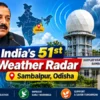
Sambalpur Weather Radar Strengthens Odisha’s Weather Preparedness
Sambalpur Weather Radar Expands India’s Observation Network
The Sambalpur Weather Radar has become India’s 51st Doppler Weather Radar. Union Minister of State for Earth Sciences Dr. Jitendra Singh inaugurated the facility virtually at Sambalpur, Odisha. Odisha Chief Minister Mohan Charan Majhi attended the programme.
The new radar will improve weather monitoring across Western Odisha and nearby regions. It will also provide meteorological inputs for Southern Jharkhand, Northern Chhattisgarh, parts of North Andhra Pradesh and West Bengal.
Mission Mausam and the Growing Radar Network
India had 14 Doppler Weather Radars in 2014. The national network has now reached 51 radars. Under Mission Mausam, the government plans around 40 more radars, taking the projected total to about 81.
Odisha now has three Doppler Weather Radars at Sambalpur, Gopalpur and Paradip. The government also plans additional facilities for Balasore, Puri and Bhubaneswar.
The Sambalpur facility will help close an important weather-observation gap. Its data will help meteorological agencies track thunderstorms, lightning, heavy rainfall and other hazards. As a result, administrations and communities can receive more timely weather information.
The government is expanding ground-based monitoring across Odisha as well. Automatic Weather Stations and rain gauges are being established at district and school-level locations. Radio sonde stations and microwave radiometers will further strengthen the observation network.
Sambalpur Weather Radar Supports Local Forecasting
Dr. Singh said the broader objective is to develop a multi-layered weather observation system. Better local data can support agriculture, disaster management, power and energy management, and other weather-sensitive sectors.
He also highlighted IMD’s regional role. The department provides weather, cyclone and flash-flood forecasting and early-warning support to 13 neighbouring countries.
The Sambalpur Weather Radar therefore adds another important capability to India’s expanding observation network. Its observations will support more localised forecasting and strengthen preparedness for extreme weather events.